Media Preservation Foundation Collection
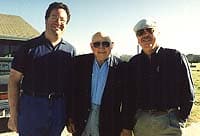
(l-r) Tracy Carman, Media Preservation Foundation, Jim Wells and Jodie Lyons, Futursonic Productions. When this photo was taken in 1995, Jim and Jodie hadn't seen each other in 30 years.
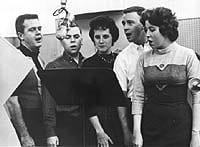
Futursonic's Versatiles vocal group, 1960. (l-r) Jodie Lyons, Brian Beck, Libba Weeks, Jerry Whitman and Judy Parma.
|
The Media Preservation Foundation, a not-for-profit organization dedicated to the preservation of media archives, is a labor of love for Tracy Carman of Massachusetts and Don Worsham of California. In 2000, while tax-exempt status was pending for REELRADIO, Media Preservation Foundation established a fund for contributions to keep the REELRADIO web site online.
The Foundation's archives include, but are not limited to:
The Foundation's objective is to "acquire the items before they make their way to a dumpster." It is the Foundation's intention to make these archives available to the public for research and educational purposes.Don Worsham has been researching and writing a book on radio ID jingles for several years, which the Foundation hopes to publish. Collectors wishing to contribute materials to the Foundation can contact Tracy Carman via e-mail, or write The Media Preservation Foundation, Box 61223, Longmeadow, Massachusetts 01116-6223. Visit Media Preservation Foundation on the web at www.jingles.org The Foundation has received both financial and material contributions to date from the Estate of Ron Lewis; the Estate of Edith Siday; Brian Beck; Ed Brouder of Man From Mars Productions; Bob Craig of WPEN Radio; Ken R. Deutsch of Ken R., Inc.; Ben Freedman of Ben Freedman Productions division of CPMG, Inc.; Chuck Herlihy of WEAT/WIRK Radio; Radio Historian Peter Kanze; Jack Kratoville of New York's WLTW (Lite-FM); Bill Shannon of Charleston's WXLY; Doug Allen Wedge; Jodie Lyons and Jim Wells, both formerly of PAMS Productions and Futursonic Productions; and Jonathan M. Wolfert of Jam Productions, Inc. amongst countless others. |
[By Uncle Ricky]
When I was working on The Pete Townshend Special, I asked Tracy Carman of Media Preservation Foundation to contribute a quick copy from his PAMS reference tapes for Radio London, “Wonderful Big L”, the legendary pirate station. I had some technical problems in the transfer, and some of the cuts are a bit gritty, fidelity-wise. But I used all but a few in this composite.
This sampler begins with Series 31 and some male acapellas, and then (about 2:56) Boomp-Ding! signals the start of a super selection of Series 17 and 18, and maybe others, (I’ve never claimed to be an expert on PAMS.)
I doubt the dramatic Series 17 tells you more, says it better voice-over stuff was ever used as it is presented here. (Who was the voice?) And the if you wanna sell in England finale made me wonder: How the heck can you (legally) sell radio time on a Pirate station?
The Millenium One Sneak Preview Sampler represents just the tip of the iceberg when it comes to the tapes we are in the process of transferring from the TM Century, Inc. library. Over the years, TM and its predecessors acquired several companies including the Media General/Tanner Group, Ed Yelin Productions, Parma Productions, Sterling Sound and more. While station reference tapes are not readily available for all of the companies, we are transferring what does exist. So far, for example, the Pepper/Tanner company archives alone fill over 50 compact discs  and there are still many more to do.
The final Millenium One sampler will run approximately seventy minutes and be representative of the materials transferred up to that point in time. Subsequent Millenium samplers will pick up when their predecessor leaves off. In this manner, there will hopefully be some sort of representation of the entire vast library available. Bear in mind that the transfer process is not always an easy process. Many of the thousands of tapes haven’t been played in over thirty years and require a lot of T.L.C.
A lot of Pepper/Tanner material is included on this sampler because those were the first boxes transferred. Most, if not all of the TM material included on this sampler, and probably the Pepper/Tanner cuts are available for syndication, if anyone wants them re-sung. Of course, the singers will be on key for the Tanner cuts. (smile)
We are grateful to the crew at TM Century, Inc. for their cooperation in making these historic tapes available to the Foundation. We look forward to making these compailations available to the general public in the near future. All materials are ©2000 TM Century, Inc. and Media Preservation Foundation, and all rights are reserved.
|
Here are two different EBS Test jingles sold by TM Productions® in the seventies. Note the typically well-rounded TM voices! There were a couple of alternate versions utilizing a sonovox, too. Ron Harris provided this to the Media Preservation Foundation.
Dan Ingram performs The Make It Fit Blues over a PAMS Series 29 pre-record.
Tracy Carman writes, “I think this cut is self-explanatory.”
Commercial Recording Corporation (CRC) was started in 1955 by Tom Merriman, Hoyt Hughes, and Charlie Meeks. Merriman, like PAMS’ Bill Meeks, had worked with radio pioneer Gordon McClendon at KLIF. In April 1957, the company created the first modern ID jingle package produced in Dallas (CRC Series #3.)
Near the end of 1958, Merriman created a new package for WHBQ (Memphis), one of the Don Lee RKO stations. It was CRC Series 8, featured here. This was the original “Wonderful” package and it featured Merriman’s distinctive “dance band” style of arranging. San Diego station KCBQ received this package. In addition to pilot station WHBQ, CRC Series #8 ran on WDGY WBZ, WAKE, WISH, KIOA, WODY, KRIO, WADO, WKHM and nearly every major Top 40 station in the country.
By Uncle Ricky
Tracy Carman of the Media Preservation Foundation keeps our memories alive with Part 2 of TC’s 1998 PAMS Sampler. It’s another REELRADIO exclusive with SO much that patience is the payoff. If you don’t stick with it, you’ll never hear the rare KRTH or … At 20.7 G2 (or better) the vast variety becomes the ultimate treasure. Sounds GOOD if you can stream on the high side.
Enhanced for those with G2 capability (up to full 16 Khz response if you can maintain 32 Kbps), part two of this sparkling salute includes more classics than you can shake a stream at. The NAB finale that claimed my quote is only an itsy-bit of a big, BIG Memorial Day 1999 treat, courtesy of the Media Preservation Foundation. Gosh, you must listen. Please do.
PAMS jingles are the copyrighted property of PAMS of Dallas.
By Uncle Ricky
In November of 1998, the Repository was delighted to receive TC’s 1998 PAMS Sampler. This REELRADIO exclusive was assembled by Tracy Carman, of the Media Preservation Foundation.
Enhanced for those with G2 capability (up to full 16 Khz response if you can maintain 32 Kbps), this bountiful and clever composite includes many PAMS jingles for at least a hundred radio stations. (We didn’t count, but it’s a bunch.) We remind you that all PAMS jingles are the copyrighted property of PAMS of Dallas.
We hope we’re on the mailing list for the next TC sampler! For now, Enjoy!
Futursonic’s unique tight vocal harmony is heard in “Swingin’ Sound.” The package (heard here for WMAK, Nashville) was only the fourth ID series produced by Futursonic. It was created near the end of 1959. Many of the cuts were also created by Jodie Lyons (see “The Versatiles Days of the Week”, below.) The package contains the first cuts written by Lyons.
Overall creative control of Futursonic was in the hands of Jim Wells. He and Jack Alexander started the company in 1958. Both came from PAMS where Wells had written much of PAMS Series #6. Alexander was part of the PAMS sales staff.
Futursonic’s first package was “Pacemaker” produced in September, 1958. It was followed by “Most Happy Sound” for CHUM in mid 1959, and “Econo-Pack” for WINS in June, 1959. These packages slowed CRC’s growth and cut deeply into the PAMS market. All were designed for Top 40 Radio.
[Curator’s Note: An example of on-air usage of several cuts in this series can be heard in the closing minute of WFUN Fundamental News, 1961.]
Modern ID jingles use a musical logo which is sung with the call letters. The first company to do this was Johnson Siday in 1954, in jingles done for WWSW.
Their primary work was in advertising. They created the 1939 “Pepsi Cola hits the spot” commercial jingle and went on to develop the musical logo in their commercials.
Eric Siday called the musical logos “Identitones” His work is featured in this demo tape which includes the famous ABC Radio news logo used for many years to introduce the network news at :55. Siday is considered a pioneer in the development of electronic music. His use of the Moog, filters, reverse taping, and recording off speed are all shown in his 1968 “Identitone” demonstration tape.
Tracy Carman writes:
“This is an aircheck from the day the music died: WNBC – The First 66 Years. It was contributed by Peter Kanze who provided the bulk of actualities and airchecks for the special, which is narrated by Dale Parsons. Dale is now in Hawaii, doing consulting, voice overs and enjoying the weather.
I remember sitting in my car, in the rain, listening to Alan Colmes do the final ID. They played the NBC chimes (the musical notes G E C, for General Electric Corporation) … followed by the start of Sports Radio 66 – WFAN.”
This special aired on October 7, 1988, from 12:10 pm – 1:40 pm.