
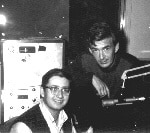
Tom Clay was an extraordinary disc jockey and an extraordinary human being. He was extraordinary in the sense that his program did not follow the norm. He did not do the ordinary. He was an exceptional story-teller, and he interspersed the records he spun with tales of the experiences that shaped his life. His program was different. It was dimensional. It was not for everyone. Tom Clay came from the Detroit market, where he’d worked at WJBK. He was in the starting lineup (with Humble Harve, included on this aircheck with a promo for his morning show) of the top 40 format that KBLA Burbank unveiled in February 1965, just a few months before Boss Radio broke big-time in Los Angeles. At the time of this aircheck, Boss Radio was less than two weeks old.
Until that time, KBLA operated invisibly on 1490 kHz with 250 watts. Although it was within the Los Angeles metropolitan area, few knew the station existed. Then the station was awarded a construction permit to shift to 1500 kHz with 10 kilowatts days, 1 kilowatt at night and an absolutely abysmal coverage pattern by virtue of its transmitter locationâ€â€clinging to the side of a barren mountain above Burbank. The signal nulled in the parking lot of the station at 131 E. Magnolia, within view of the towers. Nevertheless, Tom Clay held forth with his “Words and Music” program 4-8 p.m. nightly. The KBLA experiment lasted only two years, but enjoy it at its best on this Tom Clay aircheck.
And I have a Tom Clay story of my own to tell. When I was a high school kid, enamored with radio, he allowed me to visit him in the studio. We talked radio, careers, technique…and then, while a record played, he stood up and invited this starry-eyed kid–me– to sit in the chair at the console. And he said to me, “You know what? I’ll bet one day you’ll be sitting here in this studio at the controls.” I forgot about that comment until a phone call I received in 1970 from IBEW (International Brotherhood of Electrical Workers). At that time I was working part-time as an engineer at KIEV in Glendale, the neighboring community. The union asked if I’d like to take a regular shift as a studio engineer for the west coast feed of the Mutual Broadcasting System –working at the old studios of KBLA (by then known as KBBQ). I wound up running the board literally across the glass from the studio in which I’d visited Tom Clay five years earlier.