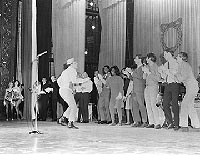
Murray’s antics on the air, on the streets, in the subways, and overhead (broadcasting from Air Force jets), combined with his natural showmanship to earn him a virtual franchise in live events. As the host of personal appearances by hot bands at local movie theatres or as the emcee of four-times-a-year rock ‘n’ roll shows at the Brooklyn Fox Theatre, Murray developed the first truly multi-racial audience. Like Freed before him, Murray Kaufman believed in the talents of black and Latin artists and preferred to play their records rather than the cover versions recorded by white singers. By building preference for a wide variety of music on the air (including Frank Sinatra, whose music opened every show), Murray attracted fans from every strata to his live shows and, in their passion for the music, tensions had virtually no opportunity to develop.
Kaufman went live in other ways. He became the unofficial American spokesman for The Beatles, thanks to touring American groups who were the opening acts at Beatle concerts in Great Britain (before the group arrived in America). When Brian Epstein asked for advice, those performers advised Brian Epstein to get in Kaufman’s good graces if he wanted the Beatles to succeed in the States. New York was the market they had to own, and Kaufman owned New York in the ratings.